Australia · FY 2026–27
Australian stamp duty calculator
Pick your state for its full calculator, or enter one price below to compare all eight.
FY 2026-27 rates · verified against the official sources.
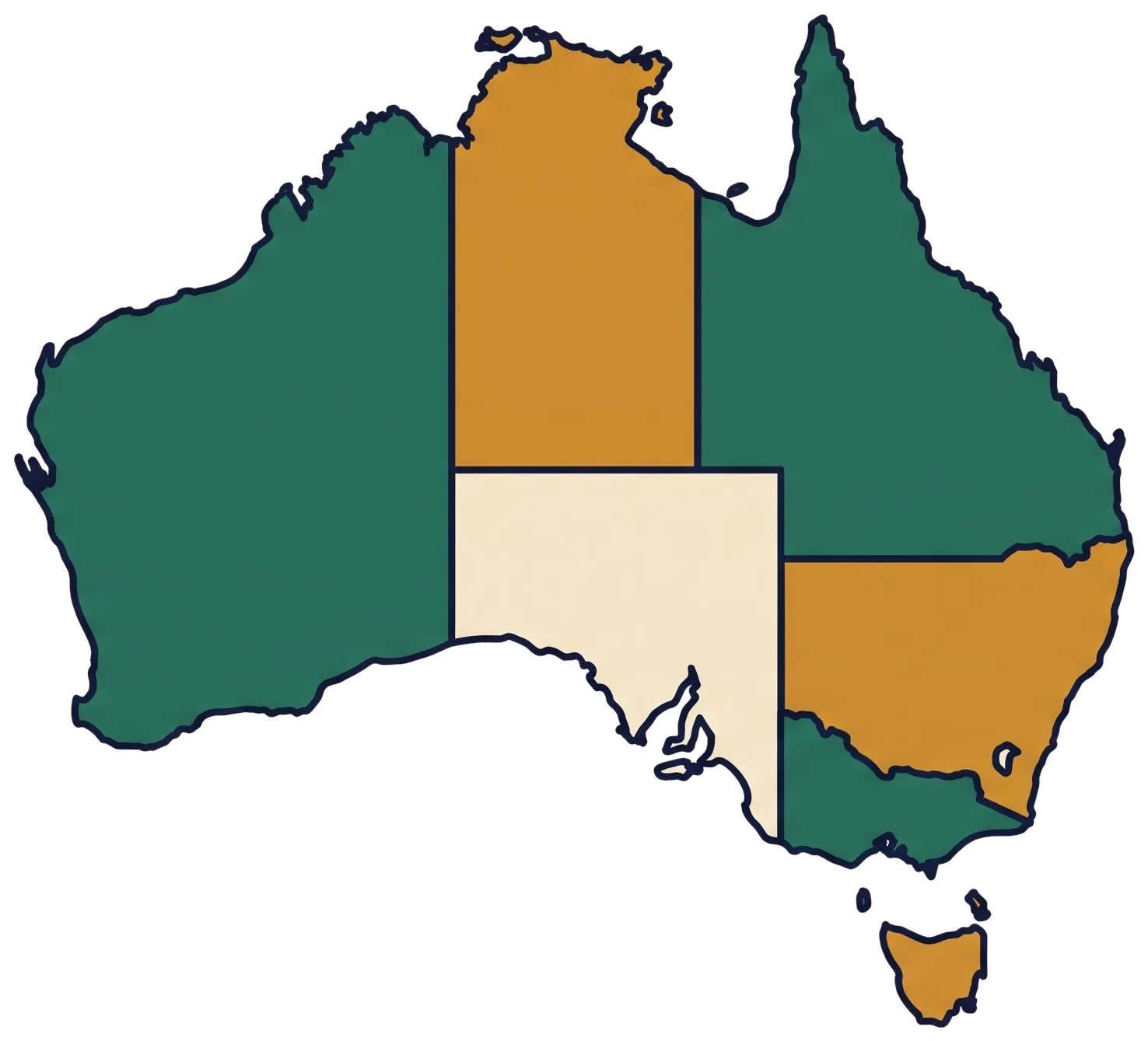
| StateJurisdiction | Owner-occupier duty | First home buyer (established) | Commercial property |
|---|---|---|---|
| NSWNew South Wales | — | — | — |
| VICVictoria | — | — | — |
| QLDQueensland | — | — | — |
| WAWestern Australia | — | — | — |
| SASouth Australia | — | — | — |
| ACTACT | — | — | — |
| NTNorthern Territory | — | — | — |
| TASTasmania | — | — | — |
One stamp duty calculator for all of Australia: pick your state above, or compare what the same house price costs in every jurisdiction. Each figure is computed from the revenue offices' current schedules by the same tested engines as our calculators — owner-occupier rates, first home buyer relief and foreign surcharges included. Each state's own calculator adds concessions, surcharges and eligibility detail.
Owner-occupier stamp duty, state by state
Duty for a buyer purchasing a home to live in, at each state's standard owner-occupier treatment (Victoria's principal place of residence concession, Queensland's home concession, the ACT's eligible owner-occupier rates, and WA's concessional rate on a home worth $200,000 or less; elsewhere the general schedule — no first-home concessions applied here):
| StateState / territory | $500,000 | $650,000 | $800,000 | $1,000,000 |
|---|---|---|---|---|
| NSWNew South Wales | $16,687 | $23,437 | $30,187 | $39,187 |
| VICVictoria | $21,970 | $34,070 | $43,070 | $55,000 |
| QLDQueensland | $8,750 | $15,100 | $21,850 | $30,850 |
| WAWestern Australia | $17,765 | $24,890 | $32,316 | $42,616 |
| SASouth Australia | $21,330 | $29,580 | $37,830 | $48,830 |
| ACTACT | $8,408 | $14,888 | $22,158 | $33,958 |
| NTNorthern Territory | $23,929 | $32,175 | $39,600 | $49,500 |
| TASTasmania | $18,248 | $24,623 | $31,185 | $40,185 |
Ranked totals with the land registry's fees added, and the exact prices where one more dollar costs thousands, are on the stamp duty statistics page.
Each state name links to its full calculator, with the schedule, concessions and sources. Prefer to do the maths yourself? The step-by-step guide walks through every state's method with worked examples.
The $800,000 question: $21,220 between the cheapest and dearest state.
On the same $800,000 home, an owner-occupier pays $21,850 in Queensland and $43,070 in Victoria. Stamp duty is the biggest single reason moving costs differ between states.

What a first home buyer pays on a $650,000 home
2026 redrew this map: the ACT abolished first-home duty on 1 July, WA lifted its thresholds in May, and Tasmania's exemption expired in June. Duty for an eligible first home buyer on a $650,000 home:
| State / territory | Established home | New home | The rule |
|---|---|---|---|
| New South Wales | $0 | $0 | New or existing home; free to $800k, concession under $1m |
| New or existing home; free to $800k, concession under $1m | |||
| Victoria | $11,357 | $11,357 | New or established; free to $600k, taper to $750k |
| New or established; free to $600k, taper to $750k | |||
| Queensland | $0 | $0 | Established: free to $700k, then a stepped concession that runs out at $800k. New homes: free at any price |
| Established: free to $700k, then a stepped concession that runs out at $800k. New homes: free at any price | |||
| Western Australia | $8,075 | $8,075 | Free to $600k, taper to $800k (from 7 May 2026) |
| Free to $600k, taper to $800k (from 7 May 2026) | |||
| South Australia | $29,580 | $0 | New homes only: free at any price. Established: no relief |
| New homes only: free at any price. Established: no relief | |||
| ACT | $0 | $0 | Abolished for first home buyers from 1 July 2026 — any home, any price, no income test |
| Abolished for first home buyers from 1 July 2026 — any home, any price, no income test | |||
| Northern Territory | $32,175 | $32,175 | No first-home concession. A new house-and-land package is exempt for any buyer who lives in it, on contracts to 30 June 2027 |
| No first-home concession. A new house-and-land package is exempt for any buyer who lives in it, on contracts to 30 June 2027 | |||
| Tasmania | $24,623 | $24,623 | FHB exemption ended 30 June 2026 — full duty now applies |
| FHB exemption ended 30 June 2026 — full duty now applies | |||
Eligibility conditions apply everywhere: owner-occupancy periods and prior-ownership tests. The new-home column is the first-home schedule only, so the NT’s house-and-land exemption, which is open to any buyer who lives in the home rather than to first home buyers alone, is not in it.
The duty concession is only one of two things a first home buyer is offered. On a new home every state but the ACT also pays a grant, from $10,000 to $50,000, and the First Home Owner Grant in every state adds the two together at one price.
Commercial property: where the rules part company
Most states charge a shop, office or warehouse on the same general schedule as an investment home. Two do not, and two more have a twist. The live table above has a commercial column; here is the same comparison at three prices.
| StateState / territory | $1,000,000 | $2,500,000 | $5,000,000 |
|---|---|---|---|
| NSWNew South Wales | $39,187 | $118,787 | $256,287 |
| VICVictoria | $55,000 | $142,500 | $305,000 |
| QLDQueensland | $38,025 | $124,275 | $268,025 |
| WAWestern Australia | $42,616 | $119,866 | $248,616 |
| SASouth Australia | $0 | $0 | $0 |
| ACTACT | $0 | $125,000 | $250,000 |
| NTNorthern Territory | $49,500 | $123,750 | $297,500 |
| TASTasmania | $40,185 | $107,685 | $220,185 |
- South Australia charges nothing. Land used for something other than housing or farming has paid no duty on contracts since 1 July 2018; vacant land counts only if it is in a non-residential zone. Buy it in the same deal as residential land, though, and the two are added together, which pushes up the rate on the residential part.
- The ACT has its own commercial scale, and it is a cliff: nil up to $2,100,000, then 5% of the whole price, so one dollar over the line costs $105,000. Any commercial use of part of a property puts all of it on this scale, which is why a shop with a flat above at or under the threshold pays nothing. How the ACT rounds it is unconfirmed, so the live table keeps the cents.
- NSW’s premium rate is for homes only. Commercial land never pays the 7% tier above $3,870,000, so above that price it costs less than a home of the same value. The threshold rises with inflation each 1 July.
- Victoria is moving commercial land from duty to an annual tax. Since 1 July 2024 a purchase can enter a property into the commercial and industrial property tax reform, broadly where the land has a qualifying commercial or industrial use, the interest bought is 50% or more, and duty is charged on at least half the property’s value. That purchase pays the general rates once, and from the first calendar year after ten years the property generally pays a tax of 1% of its site value each year while the use continues. A later sale is exempt from duty, wholly or in part, if the property still has a qualifying use and one of four further tests is met, such as three years having passed since entry, so the table prices the entry purchase. Changing an exempted property to a non-qualifying use, such as housing, can bring the duty back, less 10% for each 31 December that has passed. Commercial and industrial land wholly in regional Victoria can get 50% off if its use starts within two years and continues for at least 12 months. The State Revenue Office sets out each test.
- Queensland, WA, Tasmania and the Northern Territory charge the general schedule, as for an investment home.
Every state works duty out on the price including GST. Foreign buyer surcharges apply to residential land, and Tasmania’s to farmland too, so commercial land used wholly for business attracts none; buying commercial land to convert to housing (Victoria, WA), or a mixed-use property (NSW, on its residential part), can bring it back.
Foreign buyer surcharges
Foreign purchasers of residential property pay an additional percentage of the full price on top of ordinary duty in six of the eight jurisdictions:
| State | Surcharge | Name |
|---|---|---|
| NSW | 9% | Surcharge purchaser duty |
| VIC | 8% | Foreign purchaser additional duty |
| QLD | 8% | Additional foreign acquirer duty |
| TAS | 8% | Foreign investor duty surcharge |
| WA | 7% | Foreign transfer duty |
| SA | 7% | Foreign ownership surcharge |
| ACT | None | No duty surcharge |
| NT | None | No duty surcharge |
On a $1m purchase that's an extra $90,000 in NSW — often more than the underlying duty itself. The foreign buyer calculator computes both layers on your price, and covers the federal policy against foreign purchases of established homes, set to run to 30 June 2029.
The annual tax that follows: land tax thresholds
Stamp duty is the one-off; land tax is the annual bill investors keep paying. The tax-free thresholds vary even more than duty does — Victoria taxes investment land from just $50,000 (VIC calculator), Queensland from $600,000 (QLD calculator), and NSW from a frozen $1,075,000 (NSW calculator).
Frequently asked questions
Which state has the highest stamp duty?
Which state is best for first home buyers in 2026?
Is stamp duty being abolished in Australia?
Are these stamp duty figures official?
Embed this calculator on your site
Conveyancers, brokers, agents: add the Stamp duty calculator, every state to your own website free of charge. Paste this snippet anywhere HTML is accepted — it stays up to date automatically, because it renders from the same tested engine as this page. We only ask that the attribution line stays visible.
The attribution links carry rel="nofollow", which is what Google asks of any link distributed through a widget — so adding this cannot affect your own site's rankings either way. See every calculator you can embed, and the terms, on one page.
Method & sources
Home-buyer figures are generated at build time by the same engines that power each state calculator, which are pinned by automated tests to the revenue offices' published schedules and worked examples (Revenue NSW, SRO Victoria, QRO, WA DoF, RevenueSA, ACT Revenue Office, NT Territory Revenue Office, SRO Tasmania) — see each state page for its sources, and the methodology for how verification works. Rates last verified 2026-08-27 for FY 2026-27. No state page prices commercial property, so the commercial column has its own engine, tested against the revenue offices’ examples where they publish one, and its sources are listed below. General information only — not financial, legal or tax advice.
Commercial property, read on 4 October 2026:
- New South Wales: Revenue NSW — Premium property duty (residential land only); Revenue NSW — Surcharge purchaser duty overview (mixed use)
- Victoria: SRO — Entry into the commercial and industrial property tax reform; SRO — Dealings in properties that have entered the reform; SRO — Regional commercial, industrial and extractive industries property concession; SRO — Understanding foreign purchaser additional duty
- Queensland: QRO — Transfer duty rates (commercial or investment property)
- Western Australia: WA Treasury and Finance — Transfer duty assessment (general rate); WA Treasury and Finance fact sheet — Foreign Transfer Duty, 23 May 2025
- South Australia: RevenueSA — Real property (land): no duty on qualifying land
- ACT: Taxation Administration (Amounts Payable—Duty) Determination 2026, DI2026-155, Part 3; ACT Revenue Office — Conveyance duty for commercial property
- Northern Territory: NT Government — Examples of duty and rates (commercial land included)
- Tasmania: SRO Tasmania — Rates of duty
Primary schedules: Revenue NSW, SRO Victoria, QRO, RevenueWA, RevenueSA, SRO Tasmania, ACT Revenue Office and the NT's TRO.
Journalists and researchers: you're welcome to cite these tables with a link to this page.