Australia · 2026 & FY 2026-27
Land tax calculator, every state
Type one land value and compare every state’s annual land tax side by side.
2026 & FY 2026-27 rates · verified against the official sources.
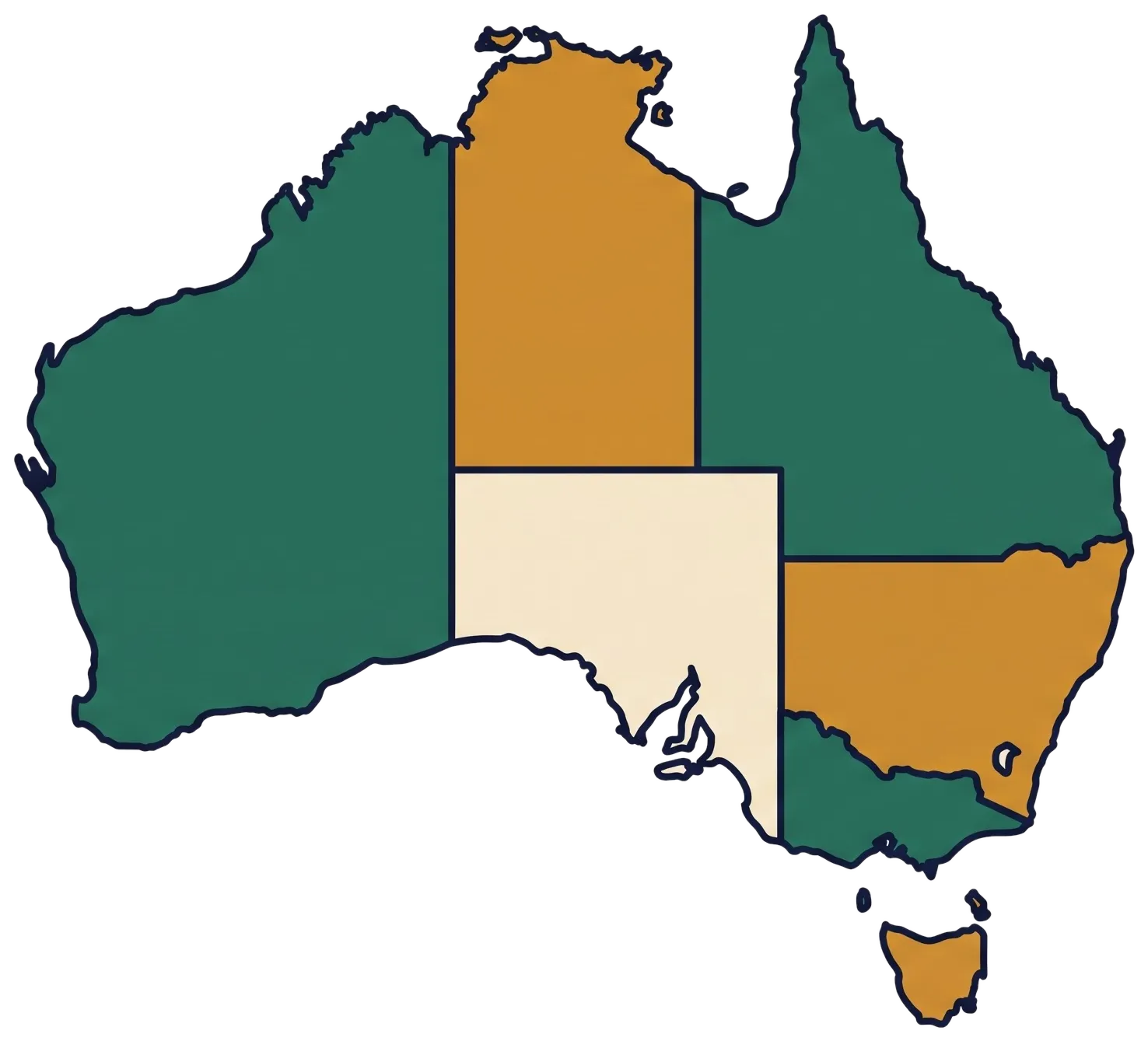
| Jurisdiction and threshold | Annual land tax | Assessed on |
|---|---|---|
| ACTNo threshold: every rental pays | $9,898 | AUV, per property (never added together) |
| Victoria$50,000 threshold | $3,450 | Site value at 31 Dec, all land added together |
| Tasmania$125,000 threshold | $6,237.50 | Assessed land value at 1 Jul, general land only |
| Western Australia$300,000 threshold | $1,250 | Unimproved value at 30 Jun, all land added together (MRIT extra in Perth) |
| Queensland$600,000 threshold | $2,500 | Statutory land value at 30 Jun, all land added together |
| South Australia$936,000 threshold | Nil | Site value at 30 Jun, all land added together |
| New South Wales$1,075,000 threshold (frozen) | Nil | Averaged land value at 31 Dec, all land added together |
| Northern TerritoryNo land tax at all | $0 — ever | The only jurisdiction without one |
Ordered from the lowest tax-free threshold to the highest.
One land value, seven very different bills. Thresholds run from Victoria's $50,000 to NSW's $1,075,000, the ACT taxes every rental from the first dollar, and the Northern Territory charges nothing at all.
The threshold spread is 21.5-to-1 — before you reach the two that don't fit the scale at all.
Victoria taxes investment land from $50,000; NSW waits until $1,075,000 — 21.5 times higher. Then the ACT ignores thresholds entirely (every non-owner-occupied home pays, from the first dollar), and the NT never sends a bill.
How the seven systems differ
Every mainland state plus Tasmania taxes the aggregated value of your investment land once it crosses a threshold — but they disagree on everything else. The taxing date is 31 December in NSW and Victoria (calendar tax years) and 30 June or 1 July everywhere else. The value base is the Valuer-General's land-only figure under different names — site value, unimproved value, assessed land value — never the market price of the house. Trusts pay more in Victoria and SA, companies and trusts get their own scale from $350,000 in Queensland, special trusts get no threshold in NSW, and trusts are treated like anyone else in WA and Tasmania. Foreign or absentee owners pay surcharges in NSW (5%), Victoria (4%), Queensland (3%), Tasmania (2%) and the ACT (0.75%) — but not in SA or WA.
The ACT stands alone: no threshold, no aggregation, a $1,778 fixed charge per rental plus a scale on the property's five-year-averaged value, billed quarterly. And the Northern Territory funds itself without any land tax — the only jurisdiction where holding investment land costs nothing annually in state tax. For the method itself — aggregation, thresholds and the schedules — the step-by-step guide walks through all seven systems.
Pick your state

Queensland
Land tax calculator QLD
The $600,000 threshold, company and trust rates, and the 3% foreign surcharge.
Open calculator →

New South Wales
Land tax calculator NSW
The frozen $1,075,000 threshold, premium rate and special trust rules.
Open calculator →

Victoria
Land tax calculator VIC
The $50,000 COVID-levy threshold, trust schedule and absentee surcharge.
Open calculator →

Western Australia
Land tax calculator WA
The unchanged-since-2015 scale, the flat $300 band and Perth's MRIT.
Open calculator →

South Australia
Land tax calculator SA
The indexed $936,000 threshold, trust rates, and RevenueSA's exact rounding.
Open calculator →
Tasmania
Land tax calculator TAS
The $125,000 threshold on general land, and the 2% foreign surcharge.
Open calculator →

ACT
Land tax calculator ACT
The per-rental fixed charge plus AUV scale, billed quarterly.
Open calculator →
Frequently asked questions
Which state has the highest land tax?
Which state has no land tax?
Is land tax payable on my own home?
Do thresholds apply per state or across Australia?
Why is the ACT so different?
Are these land tax figures official?
Method & sources
Figures are computed live by the same engines that power each state calculator, pinned by automated tests to the revenue offices' published scales, worked examples and online calculators (Revenue NSW, SRO Victoria, QRO, WA Treasury's payable tables, RevenueSA's calculators to the cent, SRO Tasmania's published example, and the ACT's 2026 determination). See each state page for its sources, and the methodology for how verification works. Rates last verified 2026-08-28. General information only — not financial, legal or tax advice.
Primary schedules: Revenue NSW, SRO Victoria, QRO, RevenueWA, RevenueSA, SRO Tasmania, ACT Revenue Office and the NT's TRO.
Journalists and researchers: you're welcome to cite this comparison with a link to this page.